
“I know the answer. Sometimes I’m completely sure of it. But the moment my teacher asks the class a question, I suddenly feel nervous about raising my hand. I start thinking I’ll say it wrong, everyone will look at me, or I’ll sound stupid“.

If you’ve ever had the right answer in your head but couldn’t get your hand to go up, you know how frustrating this can be.
You may even be perfectly comfortable talking to your friends. But answering in front of the whole class feels completely different.
The good news is that you don’t need to become extremely confident overnight. You can make this easier by practicing small, specific things.
Use the 5-second rule
This is especially useful if your problem is overthinking.
You know the answer> You think about raising your hand> Then your brain starts:
‘What if I’m wrong?‘, ‘Maybe someone else will answer‘, ‘What if I can’t explain it?‘
And five seconds later, you’ve decided not to participate.
So try this: If you know the answer, raise your hand within five seconds.
Don’t wait until you feel brave. You’re probably never going to feel 100% ready if you keep giving your nervous thoughts time to argue with you.
Prepare one sentence before class
If you know a particular topic is going to be discussed, prepare a few answers beforehand.
Not a whole speech. Just one or two sentences. This can be especially helpful if your problem isn’t knowing the answer but freezing when you have to say it.
Practice saying answers out loud
Knowing the answer in your head isn’t quite the same as saying it.
Try this at home: Pick a few questions from your textbook and answer them out loud. You can even record yourself on your phone if you’re comfortable doing that.
Listen once, not to criticize yourself, but to get used to hearing your own voice explain something. The more familiar speaking your answer feels, the less strange it can feel in class.
If you get called on unexpectedly, pause
Don’t panic because you need two seconds to think. You can simply say:
“Let me think for a second.”
Take a breath. Then answer.
A short pause isn’t embarrassing. Teachers ask questions because they expect students to think before answering.
Sit somewhere that makes participation easier
If sitting at the very back makes you feel invisible, try sitting somewhere closer to the middle.
You don’t need to sit directly in front of the teacher. Just choose a place where you’re less tempted to hide whenever a question is asked.
Small environmental changes can make a surprising difference.
Give yourself a tiny daily target
Don’t measure your progress by: “Am I confident yet?”
Use something you can actually count. For example:
Week 1: Answer one question in class.
Week 2: Answer two questions.
Week 3: Ask one question when you don’t understand something.
That’s progress. Some days you’ll manage it easily. Other days you’ll be nervous and still do it. Both count.
Ask a friend to help you
If you have a friend you’re comfortable with, tell them:
“If I know the answer but don’t raise my hand, remind me to do it.”
You don’t need them to embarrass you or force you to speak. Just having someone quietly encourage you can help. You can also practice answering questions together before class.
Stop waiting to “feel confident”
This is probably the biggest change to make. You might think:
“Once I become confident, I’ll start answering.”
It usually works the other way around. You answer while nervous. You survive it. You do it again. You realize you can handle being wrong. You answer again.
And gradually, your brain stops treating every classroom question like a huge event.
Confidence is often the result of repeated practice, not the requirement for starting.
Try this tomorrow
Don’t promise yourself that you’ll suddenly become the most active student in class. Just do this:
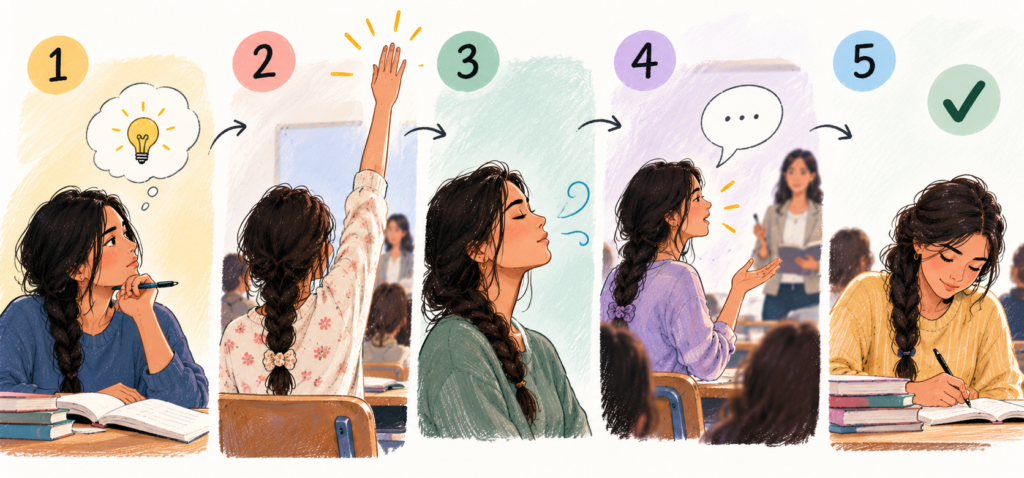
1. Pick one question you know the answer to.
2. Raise your hand before you have time to overthink it.
3. Take one slow breath while waiting.
4. Give your answer—even if your voice sounds a little nervous.
5. Move on with the class.
Don’t spend the next ten minutes analyzing how you sounded. You answered. That’s enough.
And if you never feel nervous around your friends but freeze in class…
That doesn’t mean you’re incapable of speaking.
It probably means being judged in front of a group is the part that makes you uncomfortable.
That’s something you can practice.
Start with small situations: answering a teacher, asking one question, reading one sentence aloud, or explaining an answer to a classmate. You don’t have to transform your personality. You just need to get more comfortable being heard.
One thing to remember
The girl sitting next to you probably isn’t thinking about your answer as much as you think she is.
Your teacher isn’t expecting every answer to be perfect.
And your classmates will move on to the next question much faster than your anxious brain expects.
So next time you know the answer, don’t wait until you’re completely fearless. Raise your hand while you’re still a little nervous. That’s how you start making nervousness smaller.
-Here for every her-