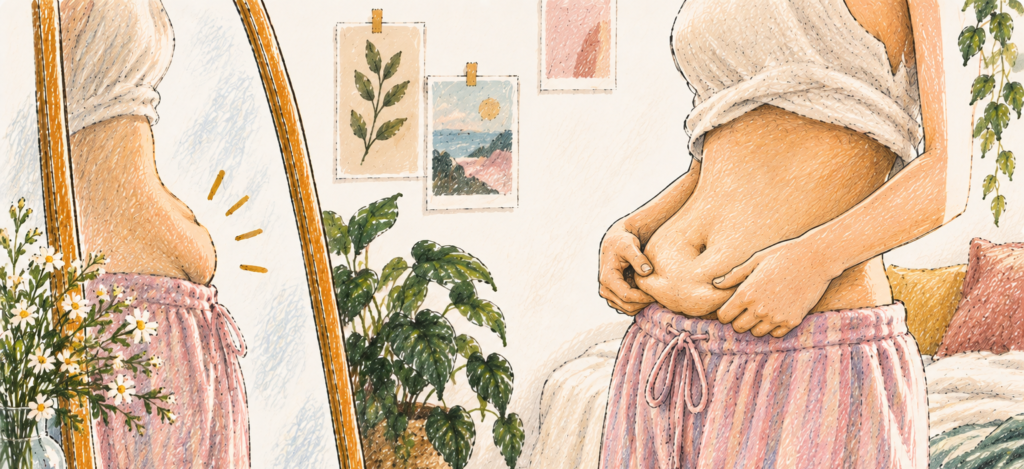
If you’ve ever looked at your stomach and wondered why it isn’t completely flat, you’re not alone.
A lower-belly pouch is extremely common even among women who are naturally thin or have a low body weight.
And having one doesn’t automatically mean you have too much body fat, that you’re unhealthy, or that you’re doing something wrong.
First: A Completely Flat Stomach Isn’t the Default
Social media can make a flat, completely smooth stomach look like the normal starting point. It isn’t.
Your abdomen contains your digestive organs, muscles, connective tissue, and other structures. Your body also naturally stores some fat, including around the abdomen.
When you stand, sit, bend, eat, or relax your abdominal muscles, the appearance of your stomach can change. So a little softness or fullness around the lower abdomen can simply be part of having a human body.
Why Do I Have a Lower-Belly Pouch?
There isn’t one single explanation. Several completely normal factors can contribute to the way your lower abdomen looks.
Natural Fat Distribution
Where your body stores fat is influenced partly by genetics and hormones.
Some women naturally carry more fat around their lower abdomen, hips, or thighs even when they are otherwise slim. You can’t always choose where your body stores or loses fat.
Your Anatomy
The shape of your abdomen isn’t determined by body fat alone. Your pelvis, abdominal muscles, skin, connective tissue, and the position of your internal organs all contribute to the shape of your stomach.
That means two women with similar body weights can have very different-looking stomachs.
Hormones
Hormonal changes can influence where the body stores fat and how much water it retains. Changes around your menstrual cycle can also temporarily make your abdomen look fuller or feel bloated.
Bloating and Digestion
Sometimes what looks like a “belly pouch” isn’t body fat at all.
Gas, constipation, eating a large meal, food intolerance, or normal digestive changes can temporarily make your abdomen look more prominent. You may notice that your stomach looks flatter in the morning and fuller later in the day. That’s normal.
Posture
Your posture can dramatically change the appearance of your stomach. When you relax your abdominal muscles, tilt your pelvis forward, or stand differently, your lower abdomen may naturally project outward.
That doesn’t mean you’ve suddenly gained fat.
Abdominal Muscle Structure
Having visible abdominal muscles isn’t simply about being thin.
Muscle development, genetics, posture, and the thickness and distribution of fat and tissue over the abdominal wall all influence how defined your stomach looks. Some naturally thin women have a soft lower abdomen. Some have visible abdominal definition. Both can be normal.
Can You Be Thin and Still Have Belly Fat?
Yes.
Being thin doesn’t mean having zero body fat. Your body needs fat for normal functions, including hormone production, energy storage, insulation, and protecting organs. Having some fat around your abdomen is not automatically unhealthy.
Body weight and body composition are also not the same thing. Someone can have a relatively low body weight and still have a different distribution of muscle and fat, while someone with a higher body weight can be perfectly healthy.
Can Exercise Get Rid of a Lower-Belly Pouch?
Exercise is excellent for your overall health and can strengthen your abdominal muscles. But you cannot reliably choose exactly where your body loses fat.
Doing hundreds of crunches or other “lower belly fat” exercises doesn’t specifically burn fat from that area.
If your goal is fitness, focus on overall strength, cardiovascular health, mobility, adequate nutrition, sleep, and consistency rather than trying to eliminate one small area of your body. And if the pouch is simply your natural anatomy, there may be nothing that needs to be “fixed.”
When Should a Belly Change Be Checked?
Most lower-abdominal fullness is completely ordinary.
However, it’s worth speaking with a healthcare professional if you notice a new, persistent, or unusual change, especially if it comes with symptoms such as:
- Significant or persistent abdominal pain
- Severe or ongoing bloating
- A firm or unusual lump
- Unexplained weight loss or weight gain
- Persistent changes in bowel habits
- Vomiting or other significant digestive symptoms
- Abdominal swelling that doesn’t go away
These symptoms can have many different causes, so it’s better to have persistent or concerning changes evaluated rather than trying to diagnose them yourself.
You Don’t Need to Earn a Flat Stomach
This may be the most important part.
You can be thin and still have a belly pouch. You can exercise regularly and still have a soft lower abdomen. You can eat a balanced diet and still have folds when you sit. And you can have a completely healthy body that doesn’t look like the edited photographs you see online.
Your stomach is not supposed to look identical every hour of the day—or every day of the month.
A lower-belly pouch isn’t automatically a problem that needs solving. Sometimes, it’s simply your body being a body.