
I keep finding jobs that look perfect for me, but then I see “experience required” and immediately feel disqualified. I have the education and I’m willing to learn, but how am I supposed to get experience when nobody will give me a first chance?

You Don’t Need to Compete With Experienced Candidates for Every Job.
Your first job search can feel like a strange trap: every job wants experience, but experience is exactly what you’re trying to get.
The answer isn’t to convince an employer that you’re secretly experienced. It’s to look for entry-level roles that are actually designed for people at the beginning of their careers. Entry-level positions can have different requirements, and some explicitly accept candidates with little or no professional experience.
Read job descriptions carefully. If a posting asks for five years of experience, it probably isn’t your opportunity. If it asks for skills you can demonstrate and describes training or entry-level responsibilities, it may be.
Your Resume Isn’t Empty Just Because You Haven’t Had a Job
You may have more relevant experience than you think, you just haven’t been paid for it yet.
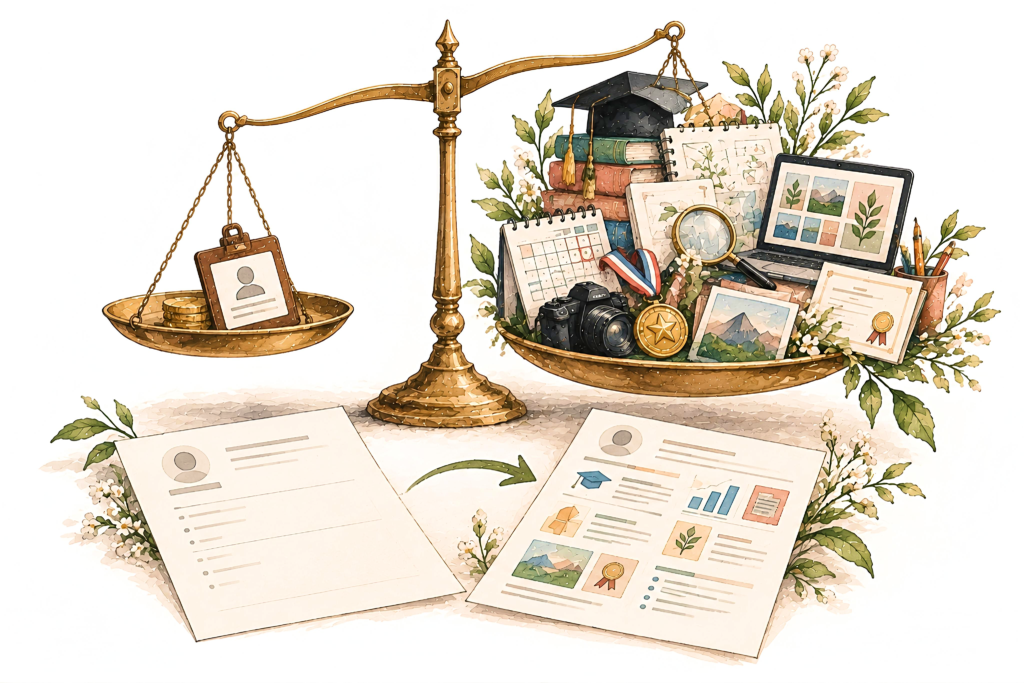
A university project, research assignment, student organization, volunteer role, competition, freelance task, personal project, or event you helped organize can demonstrate useful skills. Employers can consider education, coursework, volunteering, organizations, and projects when evaluating candidates without traditional experience.
The important part is what you actually did.
Instead of writing “Completed a college marketing project,” explain what you researched, created, analyzed, organized, or presented. Your resume should show evidence of your abilities rather than simply listing qualities like “hardworking” and “good communication.”
Build Something You Can Show
If your resume feels too thin, don’t spend six months collecting random certificates just to fill space. Build something connected to the kind of work you want.
Interested in marketing? Create a small campaign for a fictional or local business. Interested in design? Build a portfolio. Interested in data? Analyze a public dataset and explain your findings. Interested in writing? Create several strong samples.
This gives you something concrete to discuss in an interview. Recent job seekers repeatedly point to projects, academic work, and other outputs as useful ways to demonstrate ability when formal experience is missing.
Apply Strategically, Not Desperately
Sending the same resume to 100 completely different jobs can leave you exhausted without making your application stronger.
Choose a few types of roles you genuinely want. Look at several job descriptions and notice which skills keep appearing. Then adjust your resume so the relevant coursework, projects, skills, and achievements are easy to find. And don’t limit yourself to one route. Internships, volunteering, part-time work, freelance projects, and entry-level positions can all help you build evidence of your abilities.

Networking can help too but it doesn’t have to mean awkwardly asking strangers for jobs. Let people in your existing network know what kind of role you’re looking for. Sometimes someone knows about an opening before it reaches a job board.
Your First Job Doesn’t Have to Be Your Perfect Job
There is enormous pressure to make the first job the beginning of a perfect career. It doesn’t have to be.
Your first role can teach you how workplaces function, give you professional references, show you what kind of work you actually enjoy, and give you your first real line of experience on a resume.
You may need to apply more than you expected. You may get rejected for jobs you’re qualified for. That’s frustrating, but it doesn’t mean you’re unemployable.
Your first job is not supposed to prove that you’ve already built a career. It’s supposed to give you the chance to start building one.