
I thought getting my first job after college would make me feel like I had finally started my life. Instead, I spend Sunday evenings dreading Monday and wondering whether I made a terrible career choice.

There is pressure around your first job. Once you finally get hired, admitting that you hate it can feel like admitting that you failed.
But your first job is also your first real chance to discover what working life actually feels like.
Sometimes the problem is the adjustment. Sometimes the role genuinely isn’t right. And sometimes you don’t know which one you’re dealing with yet.
Do I Hate the Job or Am I Still Adjusting?
Starting full-time work can be a shock after college. There are fixed hours, deadlines, meetings, coworkers you didn’t choose, and responsibilities that follow you home mentally.
A learning curve can make a perfectly reasonable job feel awful at first.
Give yourself some time to learn the role if the main problem is feeling inexperienced, overwhelmed, or awkward. The first few months may feel very different once you know what you’re doing.
What Exactly Do I Hate About It?
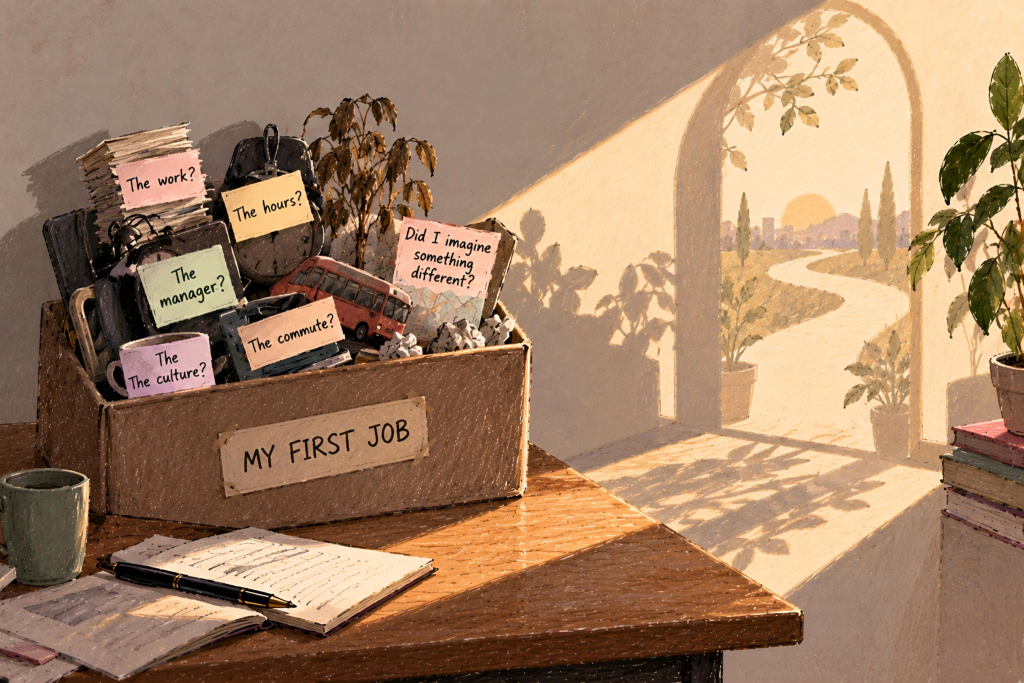
Try being painfully specific.
Do you hate the actual work? Your manager? The hours? The culture? The commute? Or did you imagine yourself doing something completely different?
This matters because some problems can change. You might be able to learn new responsibilities, ask for different projects, or improve a difficult working relationship.
But if you dislike the basic nature of the work and cannot imagine becoming happier with more experience, that tells you something different.
Am I Learning Anything That Helps My Future?
Your first job does not have to be your dream job. It can still be useful if you’re building skills, learning how your industry works, meeting people, or figuring out what you don’t want.
That counts too.
If you can look back after several months and see that you’re becoming more capable, your experience may be worth collecting before moving on. There is no universal rule that you must stay a specific number of years.
What matters is what you’re gaining, your goals, and your alternatives.
What If I Already Know I Want to Leave?
You don’t have to choose between suffering indefinitely and resigning tomorrow.
Start looking while you’re still employed if your situation allows it. Update your resume, reconnect with people you know, research other roles, and apply quietly. This gives you information about what’s available instead of deciding based only on a miserable Monday morning.
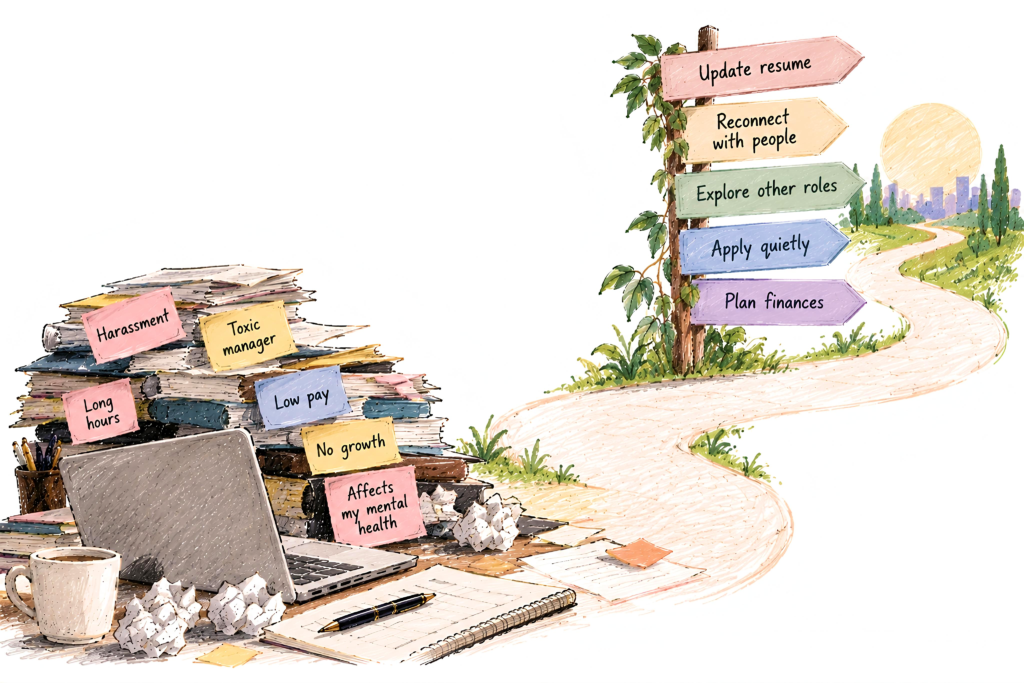
If the job involves harassment, serious mistreatment, unsafe conditions, or is significantly damaging your well-being, waiting simply to reach an arbitrary milestone may not make sense.
Your financial situation matters too, so consider your savings, expenses, and how long your job search might take.
What Would I Tell a Friend in My Position?
I’d tell her not to panic.
A bad first job does not mean she chose the wrong degree, ruined her career, or is incapable of working. People discover what suits them by experiencing what doesn’t.
Real experiences can make the next career decision much clearer.
You don’t need to prove your toughness by staying somewhere clearly wrong for you. But you don’t need to quit because the first few months are uncomfortable either.
Give yourself enough time to learn the difference between “this is new” and “this is not for me.” That distinction is much more useful than forcing yourself to stay or leave just because someone says you should.



qwxxwnejsklyrsuoldoenjrmmvmutw