My bedroom gets messy so easily, and once it reaches a certain point, I don’t even know where to begin. There are clothes on the chair, things on the floor, cups beside my bed, and random stuff I can’t even remember leaving there. I look at all of it and think, “I’ll deal with it later.” Then later becomes tomorrow, and tomorrow becomes another week. The frustrating part is that I genuinely want a clean room. I just can’t seem to make myself start.

When a room gets very messy, cleaning stops feeling like a normal household task. It starts feeling like a huge project.
You look around and see twenty different things that need doing at once. Your brain has to decide what to pick up, where it belongs, what to wash, what to throw away, and what to organize. That can make avoiding the room feel easier than dealing with it.
The solution isn’t waiting for a sudden burst of motivation. It’s making the first step so small that you don’t need much motivation at all.
Don’t Start by “Cleaning Your Room”
That sounds strange, but it makes a huge difference.
“Clean my bedroom” is too vague. Instead, give yourself one job. Collect every piece of rubbish.
You’re not cleaning the entire bedroom. You’re doing one type of thing at a time.
When you’re overwhelmed, removing obvious rubbish and laundry can make the biggest visual difference with surprisingly little effort. Try breaking an overwhelming cleaning task into smaller tasks instead of trying to tackle everything at once.
Give Yourself Ten Minutes, Not a Perfect Room
Set a timer for ten minutes and choose one task. When the timer ends, you’re allowed to stop.
You might stop after ten minutes or you might notice that you’ve finally got some momentum and keep going.
Either outcome is useful.
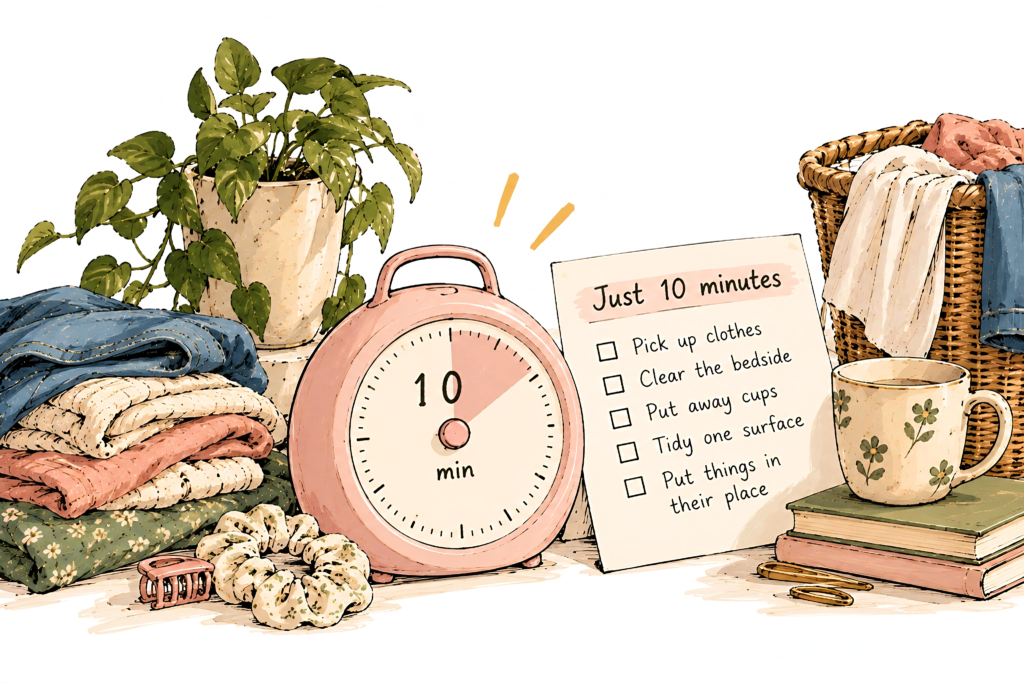
Short timers as easier to face than committing to a huge cleaning session. Ten minutes of cleaning is still ten minutes you didn’t spend avoiding it.
Make “Putting Things Away” Easier
Sometimes a messy bedroom isn’t caused by a lack of effort. Your storage system may simply require too much effort.
If putting something away involves opening three boxes and moving five other things first, you’ll eventually stop doing it.
Make the easiest place the place where the item actually gets used.
Keep a laundry basket where clothes usually come off. Keep a small bin near the bed. Give frequently used items an obvious home.
You don’t need an impressive organization system. You need one you’ll actually use.
Have a “Bad Day” Version of Cleaning
Your normal routine and your worst days don’t have to look the same.
On a good day, you might change the sheets, vacuum, dust, organize your wardrobe, and put everything away.
On a terrible day, your goal can simply be: Rubbish out, dishes out, dirty clothes together, bed cleared.
That’s enough.

A room doesn’t need to be magazine-perfect to feel better. And don’t underestimate the effect of changing one visible area. Clearing your bed can make the whole room feel different even when the rest is still messy.
The point is to maintain a basic level of order without turning every cleaning session into a massive project.
Stop Using Motivation as the Requirement
You may keep thinking, I’ll clean when I feel better. I’ll do it when I have energy. I’ll do it properly on the weekend.
But motivation is unreliable.
Play a podcast or some music while you do it if that makes the task easier. Background entertainment is a simple way to make repetitive tasks easier. And if your room becomes messy again next week, that doesn’t mean the system failed.
You live there. The goal isn’t to maintain a perfectly clean bedroom forever. It’s to make it easier to recover when life gets messy.
You don’t need to become a naturally tidy person. You need a cleaning routine that still works on the days when you have very little to give. Start with one thing. Ten minutes is enough. A better room can begin with one piece of clothing off the floor.